

What It Costs to Build and Renovate in Newton, Wellesley & Brookline (2026)
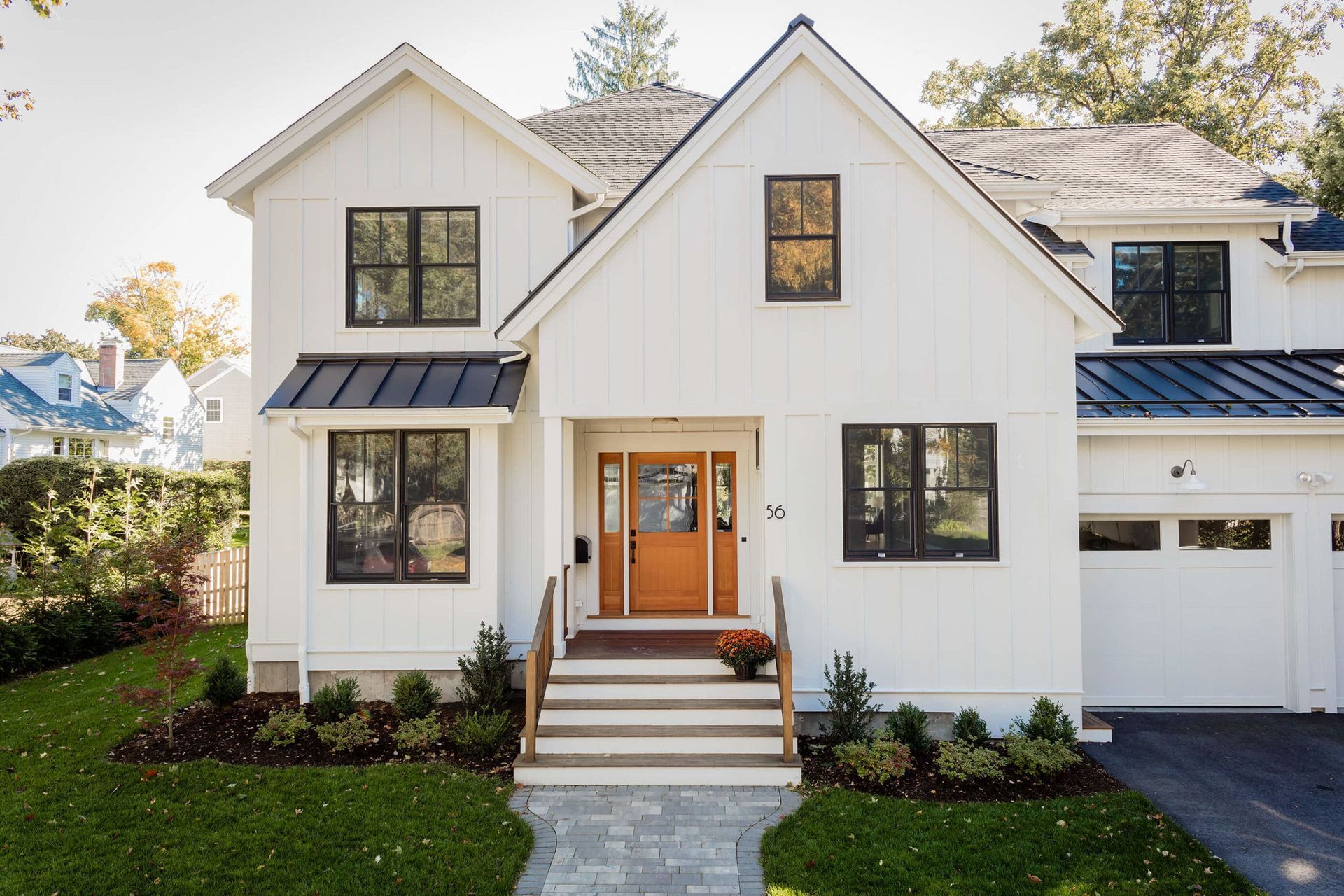
What it costs to build or renovate in Newton, Wellesley & Brookline in 2026: $/SF ranges, benchmark project costs, and what drives the numbers.
The Short Answer — and Why Every Range You Find Is Wide
If you are planning a custom home, a major addition, or a whole-home renovation in Newton, Wellesley, or Brookline in 2026, the honest short answer is this: high-end construction in these towns is priced like the housing market they sit in — among the most expensive in New England — and any single number you are quoted online is probably measuring something different from the project you have in mind.
The ranges are wide for three reasons. First, published figures mix categories: a blended average across all build types in Boston runs about $240 per square foot (Angi, updated October 2025), while true luxury custom work in Greater Boston is published at $600 to $1,200 or more per square foot. Both numbers are "real"; they are simply not describing the same house. Second, most per-square-foot figures are hard construction cost only — the house itself — with land, architecture and design fees, permitting, and landscaping excluded, adding a further 25% to 40% before you reach an all-in project cost. Third, costs are still rising: the Turner Building Cost Index was up 5.49% year over year in Q3 2026, with Turner citing skilled labor — particularly mechanical and electrical trades — as a persistent constraint, and building material costs rose 6.7% over the 12 months to July 2026 (NAHB/Wells Fargo reporting). A budget built on 2023 numbers is already stale.
What follows are the best published anchors for 2026, labeled carefully so you can tell what each number actually includes.
Cost Per Square Foot: Custom Homes, Additions, and Whole-Home Renovations
Custom homes. A 2026 Greater Boston luxury cost guide (GC Builders) puts hard construction cost for luxury custom homes at $600–$1,200+ per square foot, tiered roughly as follows: high-end custom at $500–$650/SF, true luxury at $650–$900/SF, high-performance and Passive House work at $900–$1,100/SF, and historic-district or bespoke estate work at $1,100–$1,200+/SF. Those are hard costs. Land, design fees, permitting, and landscaping sit on top — commonly adding 25% to 40% — which is why total luxury project budgets in the area commonly run $3.5 million to $7 million and up. For context, another Greater Boston luxury builder (Winter Group) publishes that custom homes "start around $450/SF" — a starting point, and one below where most Newton, Wellesley, and Brookline projects actually land. And for a national frame of reference, NAHB's Cost of Constructing a Home survey puts average U.S. construction cost at roughly $162/SF, with New England the most expensive region in the country at a $282/SF median for spec-built homes. Custom work in these three towns lives far above both anchors.
Additions. Published Greater Boston planning ranges for 2026 put most finished additions at roughly $350–$650 per square foot, with small projects costing more per foot (InnovBuilders 2026 cost guide — a single builder's guide, best used as a range check). By project type, that guide lists bump-outs at $40,000–$95,000, single-room additions at $120,000–$260,000, a primary suite with bath at $180,000–$340,000, and a full second story at $275,000–$550,000 and up. Additions tie into existing structure, systems, and finishes, which is why their per-foot cost can approach — or exceed — new construction on a small footprint.
Whole-home renovations. Winter Group publishes whole-home renovations "around $250/SF" as a starting point. Gut renovations of older houses in these towns typically price well above starting-point figures, and are better judged against the benchmark project costs in the next section.
Benchmark Projects: What Defined Scopes Cost in the Boston Market
Per-square-foot ranges tell only part of the story. These real-world benchmarks show what defined scopes actually cost — and what they return at resale.
Project — Job cost — Resale value recouped
Primary suite addition, upscale — $379,392 — 18.2%
Primary suite addition, midrange — $183,267 — 39.2%
Major kitchen remodel, upscale — $173,271 — 27.9%
Major kitchen remodel, midrange — $84,331 — 40.8%
Accessory dwelling unit (ADU) — $175,692 — 39.9%
Bath remodel, upscale — $84,165 — 34.5%
Bath remodel, midrange — $27,681 — 65.3%
Minor kitchen remodel, midrange — $28,991 — 119.2%
Two lessons fall out of this table. Small, well-chosen projects can return most or all of their cost; the big, life-changing ones — the upscale primary suite addition recouping just 18.2 cents on the dollar — do not. In markets like Newton, Wellesley, and Brookline, you build the large project because of how you will live in the house, not because it pays back at resale. Anyone who tells you otherwise is selling, not estimating.
What Drives Cost in These Three Towns Specifically
The land sets the floor. Single-family median sale prices from April through October 2026 (MLSPIN data) were $1,850,000 in Newton, $2,480,000 in Wellesley, and $2,600,000 in Brookline. Existing houses traded at $617.98 per square foot in Newton, $666.96 in Wellesley, and a region-high $764.74 in Brookline — meaning an ordinary existing house already changes hands at roughly new-construction cost per foot, which is why teardowns pencil. Even the teardown floor is high: a five-year analysis of Redfin sales (an analyst's calculation, published October 2026) found homes on small 5,000–6,000 SF lots selling at medians of about $1.2 million in Newton and $1.26 million in Wellesley — for the lot, effectively.
Review is a real line item — in time. In Wellesley, houses above the town's Total Living Area plus Garage thresholds need Large House Review — Planning Board approval before a building permit. In Newton, floor-area ratio (FAR) is the binding constraint on additions: the cap slides downward as lot size grows, and exceeding it requires a City Council special permit. In Brookline, preservation review is triggered by scope, not age — removing or covering 25% or more of a building's exterior sides and roof counts as demolition — so substantial additions and gut renovations, not just teardowns, enter review. All three towns also impose demolition delays on significant older buildings: generally 12 months, and 18 months for properties listed on or eligible for the National Register (Newton reviews buildings 50 years and older; Wellesley's review reaches houses built on or before December 31, 1949; Brookline's applies to all buildings). For the town-by-town process details, see our posts on home additions in Newton, home additions in Wellesley, and whole-home renovation in Brookline rather than repeating them here. Brookline has also adopted the state's opt-in Specialized Energy Code, which raises the performance bar — and the cost — on large new homes. One Greater Boston luxury guide puts the full arc at 18–30 months from design to move-in, including 6–10 months of design and regulatory approvals. Time is a cost: every month of review is a month of design fees, carrying costs, and escalation at roughly 5% a year.
Labor is the pressure point. With mechanical and electrical trades in persistent short supply (Turner, Q3 2026), schedules and pricing for exactly the systems-heavy work these houses require — HVAC, electrical service, plumbing — are where budgets move most.
How a Real Budget Gets Built
A credible budget for a project in these towns is not a $/SF guess multiplied by a floor plan. It is built line by line, the way the cost itself is structured: NAHB's breakdown of construction cost — interior finishes 24.1%, major systems rough-ins 19.2%, framing 16.6%, exterior finishes 13.4%, foundations 10.5%, site work 7.6% — is a useful map of where the money actually goes, and in high-end work the finishes share runs higher still.
At Hawthorn, that budget is built alongside the design, not after it. We work with the client's own architect or designer — or one of the firms we collaborate with regularly — and we join early, during design, for feasibility, budget, and buildability: Can this lot and this zoning envelope actually hold the program? As drawings develop, line items move from allowances to real numbers priced by the subcontractors and vendors who will do the work, so the budget tightens as the design does instead of surprising everyone at permit stage. The two numbers to insist on, from any builder, are what is priced versus what is still an allowance — and what escalation assumption is built in for a project that may not start for a year. How the builder–architect–designer collaboration works step by step is covered in our companion article on the design and construction process.
Frequently Asked Questions
How much does it cost to build a custom home in Newton, Wellesley, or Brookline in 2026?
For true luxury custom work in Greater Boston, published hard construction costs run $600–$1,200+ per square foot, with land, design fees, permitting, and landscaping adding roughly 25% to 40% on top. Total project budgets commonly run $3.5 million to $7 million and up.
Why is a builder's quote so much higher than the averages I find online?
Because the averages blend all build types and regions. Angi's blended Boston figure is about $240/SF across every kind of house; NAHB puts the national average near $162/SF. Custom work in these towns — with their review processes, older housing stock, and finish levels — is a different category of project.
Will a big addition pay for itself when we sell?
Usually not, on the published data. Per Remodeling Magazine's 2025 Cost vs. Value Report for Boston, an upscale primary suite addition costing $379,392 recoups 18.2% of its cost at resale, and an upscale major kitchen remodel ($173,271) recoups 27.9%. Build large projects for living value; let smaller projects carry the payback argument.
How long should we expect the whole process to take?
One Greater Boston luxury guide puts design-to-move-in at 18–30 months, including 6–10 months of design and regulatory approvals — and a demolition delay of 12–18 months is possible on a significant older house in any of the three towns before construction even begins.
When should we bring a builder into the conversation?
During design, not after it. A builder working alongside your architect or designer can test feasibility and price the design as it develops — which is when the decisions that drive cost are actually made.
Planning a project in Newton, Wellesley, or Brookline? We are glad to talk through the numbers early — before design money is spent — and give you a straight read on what your project is likely to cost and how long the path will take.